Showing posts with label anatomy. Show all posts

Tuesday, May 8, 2012

Installation: The Immortal


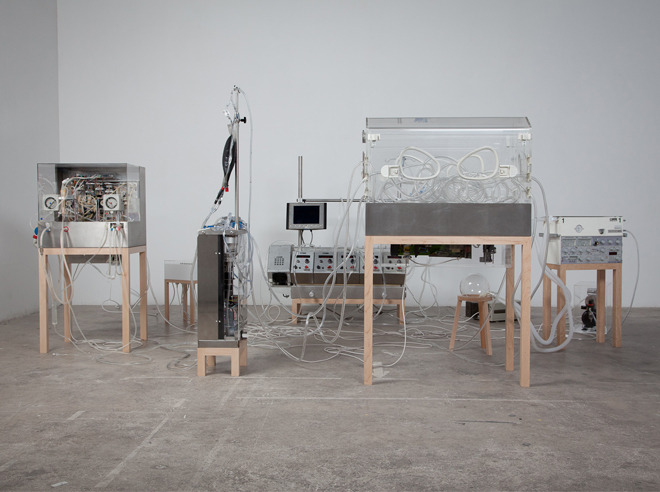
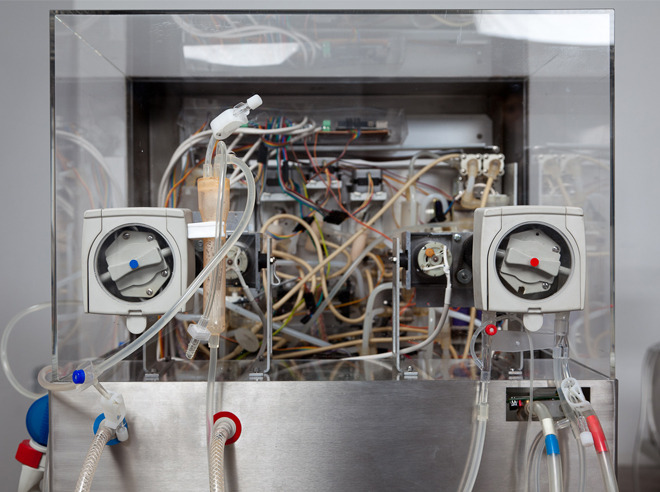
This art installation is comprised of various life-support machines  connected to each other, circulating liquids and air in an imitation of a biological structure. The piece is intended to explore human dependence on modern electronics in medicine.

   
"Salted water acts as blood replacement: throughout the artificial circulatory system minerals are added and filtered out again, the blood gets oxygenated via contact with the oxygen cycle, an ECG device monitors the system's heartbeat.

As the fluid pumps around the room in a meditative pulse, the sound of mechanical breath and slow humming of motors resonates in the body through a comforting yet disquieting soundscape."

Fresh Take: Piñata Anatomy

Piñata Anatomy by Carmichael Collective

"Piñata Anatomy" by Minneapolis-based Carmichael Lynch of Carmichael Collective

Ready to crack open that Cinco De Mayo Piñata? Before you do, you might want to take a look at what’s inside.

Wednesday, April 11, 2012

Installation: Blood Art


"Hemosapien" (BAR 1-9) by American artist Jordan Eagles2009.
Blood preserved on plexiglass using UV resin
"Through my experimental, invented process, I encase blood in plexiglass and UV resin. This preservation technique permanently retains the organic material's natural colors, patterns, and textures. The works become relics of that which was once living, embodying transformation, regeneration and an allegory of death to life.

I use various mark-making methods, including layering the blood at different densities as well as heating, burning, and aging the material. Copper, a conductor of electricity, is sometimes mixed with the blood, imparting a unique, fiery energy. Blood-soaked gauze, stretched over the surface, creates another textural layer that serves as a map of memory and homage to ancient wrapping rituals. In some instances, blood that has decomposed for years forms dense masses that are ground into dust and tossed into the works, as a sign of passing and change.

When lit, the works become translucent, cast shadows, and project a glow, appearing as if they are illuminated from within. The materials and luminosity in these bodies of work relate to themes of corporeality, mortality, spirituality, and science-invigorating blood as sublime."
Read more about Jordan Eagles at the New York Times.


"RED GIANT 1-5" by Jordan Eagles, 2011.
Sun dried blood, copper, preserved on plexiglass, UV resin


“Blood, procured from a slaughterhouse, is the primary medium in my works. Through my experimental, invented process, I encase blood in plexiglass and UV resin. This preservation technique permanently retains the organic material’s natural colors, patterns, and textures. The works become relics of that which was once living, embodying transformation, regeneration and an allegory of death to life.”


Tuesday, April 10, 2012

Illustration: The Timenauts


The Timenauts (Vtriol Collages) by Paula Braconnot
Prints available on Goodsie.com


Sculpture: Spare Parts


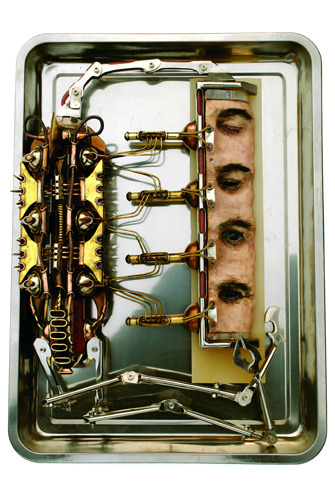
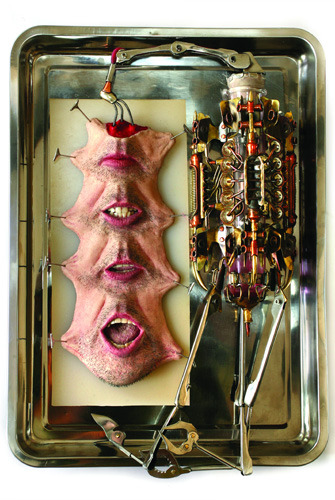
"The Spare parts represent the more successful versions of the mutant forms in the preserved series of works, engineered from embryonic cells, attached and fed by tubes attached to strange metal devices these body parts are grown as spares in the case of an accident, illness, or old age that requires the owner to have their original features surgically replaced."


Tuesday, April 3, 2012

Sculpture: Embodiment


Photographed by Brad Carlile


Tuesday, March 27, 2012

Sculpture: Anatomical Neon


A series of blown glass lights meant to focus attention on how energy is used by the human body.
"Following an International Visiting Artist Fellowship, Jessica was awarded an Arts Council Wales and Wales Arts International grant to undertake a research and development project at Urban Glass, New York. Collaborating with internationally renowed glass artists and neon specialists she produced new sculptural anatomical neon artwork inspired by biological electricity, the prescence of natural electrical activity in the human body."


"Blown glass human organs encapsulate inert gases displaying different colours under the influence of an electric current. The human anatomy is a complex, biological system in which energy plays a vital role. Brain Wave conveys neurological processing activity as a kinetic and sensory, physical phenomena through its display of moving electric plasma. Optic Nerve shows a similar effect, more akin to the blood vessels of the eye and with a front 'lens' magnifiying the movement and the intensity of light. Heart is a representation of the human heart illuminated by still red neon gas. Electric Lungs is a more technically intricate structure with xenon gas spreading through its passage ways, communicating our human unawareness of the trace gases we inhale in our breathable atmosphere."

Friday, March 9, 2012

Painting: Iris


"Iris" exhibition by British artist Marc Quinn
Six-foot Tondos of Eyeballs at the Mary Boone Gallery exhibit in New York City

Marc Quinn captures the complexity of the human eye, complete with all the subtitles of hues, tones, and shades that most people overlook. I’ve seen a lot of high definition photos of human eyes but never paintings of this size and scope.


Installation: Everything Leads to Another


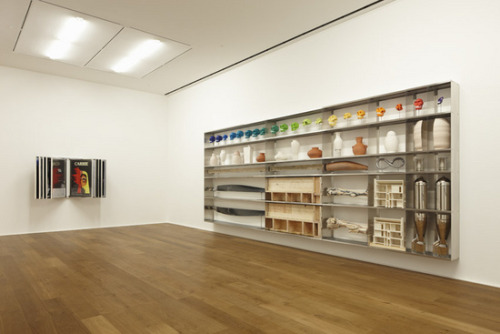
"Everything Leads to Another" by Matthew Day Jackson
On exhibit at Hauser & Wirth London on Savile Row, 2011
Photographed by Peter Mallet


Thursday, March 8, 2012

Sculpture: Wire Anatomy


Montreal-based architect, Federico Carbajal creates anatomical architectures out of galvanized wire, stainless steel and acrylic through what he calls spatial sketching.
With the influence of the old masters and the early works of Alexander Calder, to current digital 3D media and architectural representation, these tridimensional hybrids bring together drawing, architecture and sculpture in order to create a coherent spatial entity.

Spatial sketching allows for the possibility of new representations of images in space, exploring the void and the dematerialization of volume.  The physical and metaphysical presence of the human body emanate through a combination of transparent planes and spatial lines.


Capsule Figure
 Galvanized wire, stainless steel, wire mesh and glass 3” x 3” x 12”


Gesture Figure